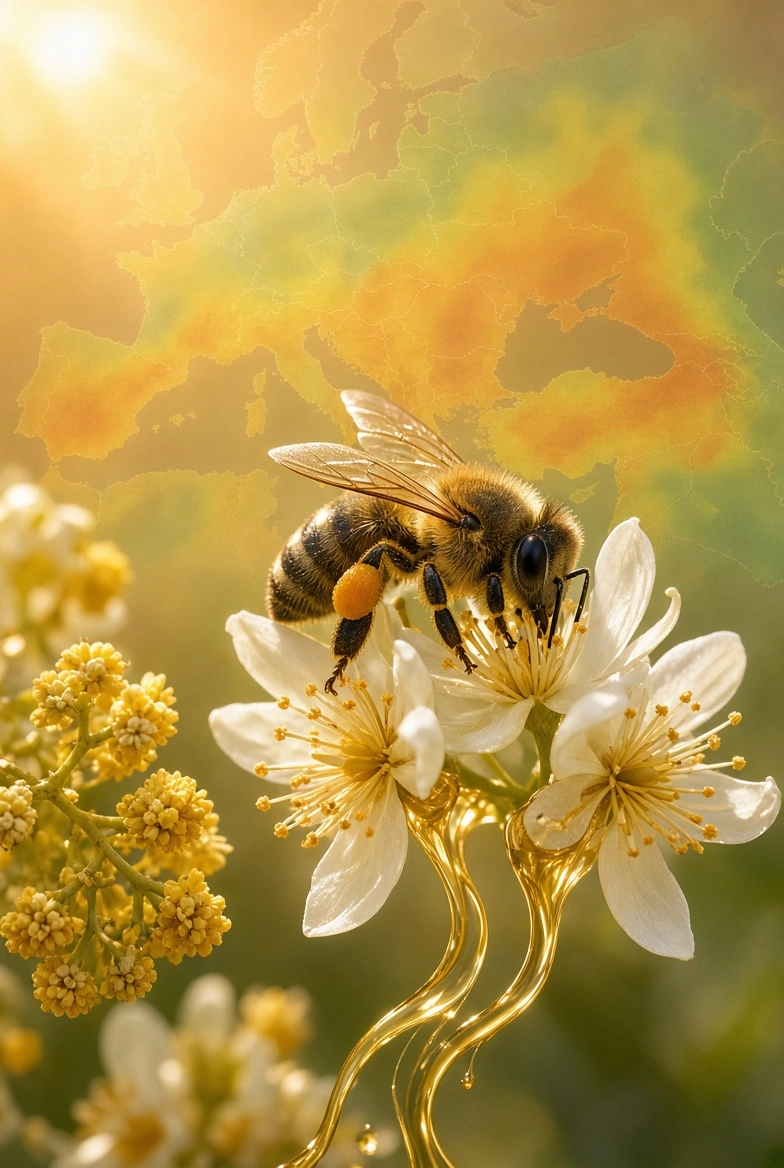
The most common question at the hive is simple: Is nectar flowing today?
Polinasyon Lab’s Nectar Flow Score answers this by combining weather data, plant phenology, and bee flight conditions into a single number between 0 and 100. The tool is free, requires no registration, and works offline once installed on your phone.
Which Countries and Locations Are Covered?
The model currently provides location-specific calculations for 322 sites across 36 countries:
- Türkiye: More than 150 locations (Aegean, Mediterranean, Black Sea, Central Anatolia, Eastern and Southeastern regions)
- Europe: Approximately 110 locations in 31 countries, including Germany, Poland, Czechia, Austria, Switzerland, the Netherlands, Belgium, Denmark, France, Slovakia, Spain, Italy, Greece, Romania, Hungary, Bulgaria and others
- Azerbaijan: 40 locations (Caspian coast, Greater and Lesser Caucasus, Kura-Aras lowland, Lankaran, Nakhchivan)
- Russia, Kazakhstan and Belarus: More than 20 locations
If you select a place that is not on the list, the app uses data from the nearest known location and displays the distance on screen.
How Is the Score Calculated?
The score is the product of three components:
score = 100 × phenology × plant potential0.6 × bee activity0.4
Multiplication is used intentionally: if plants are not secreting nectar or bees cannot fly, honey flow cannot occur — no matter how favorable the other factors are. An additive model would still produce high scores even when one critical factor is zero.
- Phenology: Tracks when plants in the region are flowering. Instead of relying on the calendar, it uses accumulated heat (Growing Degree Days – GDD) since the start of the year. In a cold spring, acacia blooms later and the score shifts accordingly.
- Plant potential: Combines temperature, atmospheric dryness (VPD), solar radiation, cloud cover, soil moisture and precipitation.
- Bee activity: Based on temperature, wind speed and rainfall conditions that determine whether bees can fly.
Alongside the score, the app also shows the limiting factor — for example “wind”, “rain” or “low radiation” — so you can understand why the number is low.
Separate Module for Pine Honeydew
In regions such as Muğla, Marmaris and Fethiye, pine honeydew production works differently from floral nectar. For these areas, a separate coefficient based on secretion temperature and relative humidity is applied. This module relies on literature assumptions and has not yet been field-validated. For more details, see our article on pine honeydew dynamics under climate change.
How Reliable Is It?
Honest answer: it is an estimate, not exact knowledge. The thresholds are based on published literature ranges.
We tested heat-accumulation flowering predictions against the Pan-European Phenological Database (PEP725) using more than 30,000 observations from Central Europe. For acacia, GDD-based predictions (adjusted for latitude and elevation) outperformed simple calendar estimates (error reduced from 10.9 days to 9.2 days). Linden showed a smaller improvement. No clear gain was observed for dandelion and willow. Full details are available in our validation study: Can acacia and linden flowering be predicted with GDD?.
This validation applies to Central Europe. Thresholds for Türkiye, Azerbaijan and Russia have not yet been independently verified and remain assumption-based in those regions. Use the score as a supporting indicator alongside your own field observations — not as a replacement for them.
How to Use It
- Open lab.polinasyon.org/nektar
- Select your location or allow the device to detect it
- View the score, the current limiting factor, and the region’s monthly flora calendar
- Add it to your home screen — it opens with the latest available data even without internet
The application is available in Turkish, English and Russian.
Full List of Covered Locations
The list below shows every location currently supported in the app (total 322). For any place not listed, the nearest available location is used.
Türkiye
Marmara (19): İstanbul, Kocaeli, Sakarya, Yalova, Bursa, Balıkesir, Çanakkale, Tekirdağ, Edirne, Kırklareli, Bilecik, Edremit, Ayvacık, Şile, Ayvalık, İznik, Gökçeada, Şarköy, Gelibolu
Aegean (23): İzmir, Manisa, Aydın, Denizli, Kütahya, Afyonkarahisar, Uşak, Muğla, Simav, Acıpayam, Tavas, Dinar, Sandıklı, Fethiye, Marmaris, Köyceğiz, Bodrum, Datça, Milas, Ödemiş, Bergama, Çeşme, Nazilli
Mediterranean (21): Antalya, Adana, Mersin, Burdur, Hatay, Osmaniye, Isparta, Kahramanmaraş, Elmalı, Kaş, Erdemli, Alanya, Anamur, Finike, Manavgat, Korkuteli, Kozan, Yayladağı, Elbistan, Eğirdir, Mut
Black Sea (30): Trabzon, Rize, Artvin, Ordu, Giresun, Samsun, Zonguldak, Sinop, Tokat, Çorum, Amasya, Kastamonu, Karabük, Bartın, Bolu, Düzce, Gümüşhane, Bayburt, Ilgaz, Tosya, Anzer, Macahel, Hopa, Çamlıhemşin, Yusufeli, Safranbolu, Niksar, Bafra, Akçakoca, Şebinkarahisar
Central Anatolia (22): Ankara, Konya, Kayseri, Eskişehir, Sivas, Kırıkkale, Aksaray, Karaman, Kırşehir, Niğde, Nevşehir, Yozgat, Çankırı, Kızılcahamam, Nallıhan, Beypazarı, Emirdağ, Beyşehir, Ermenek, Yahyalı, Suşehri, Sorgun
Eastern Anatolia (21): Erzurum, Erzincan, Kars, Ardahan, Ağrı, Iğdır, Van, Bingöl, Muş, Bitlis, Tunceli, Elazığ, Malatya, Hakkari, Çatak, Şemdinli, Uzundere, Sarıkamış, Kemaliye, Yüksekova, Kağızman
Southeastern Anatolia (16): Gaziantep, Şanlıurfa, Diyarbakır, Mardin, Batman, Siirt, Adıyaman, Kilis, Şırnak, Pervari, Birecik, Midyat, Ergani, İslahiye, Cizre, Silvan
Europe
Germany (34): Berlin, Hamburg, Frankfurt, Munich, Kassel, Erfurt, Dresden, Leipzig, Nuremberg, Würzburg, Münster, Hanover, Göttingen, Magdeburg, Halle, Regensburg, Stuttgart, Karlsruhe, Freiburg, Mainz, Koblenz, Cologne, Dortmund, Osnabrück, Chemnitz, Bayreuth, Fulda, Gießen, Trier, Kiel, Bremen, Rostock, Braunschweig, Augsburg
Austria (6): Vienna, Graz, Linz, Salzburg, Innsbruck, Klagenfurt
Belgium (2): Brussels, Liège
United Kingdom (1): London
Bosnia and Herzegovina (1): Sarajevo
Bulgaria (2): Sofia, Plovdiv
Czechia (5): Prague, Brno, Ostrava, Plzeň, Olomouc
Denmark (2): Copenhagen, Aarhus
Estonia (1): Tallinn
Finland (1): Helsinki
France (5): Marseille, Paris, Bordeaux, Lyon, Strasbourg
Croatia (2): Split, Zagreb
Netherlands (3): Amsterdam, Utrecht, Groningen
Ireland (1): Dublin
Spain (5): Madrid, Valencia, Seville, Barcelona, Granada
Sweden (1): Stockholm
Switzerland (3): Zurich, Bern, Basel
Italy (4): Palermo, Milan, Bologna, Florence
Latvia (1): Riga
Lithuania (1): Vilnius
Luxembourg (1): Luxembourg
Hungary (3): Budapest, Debrecen, Szeged
Norway (1): Oslo
Poland (8): Warsaw, Kraków, Wrocław, Poznań, Gdańsk, Lublin, Katowice, Szczecin
Portugal (2): Lisbon, Porto
Romania (3): Bucharest, Timișoara, Cluj
Serbia (2): Belgrade, Novi Sad
Slovakia (2): Bratislava, Košice
Slovenia (2): Ljubljana, Maribor
Ukraine (2): Kyiv, Lviv
Greece (3): Athens, Thessaloniki, Heraklion
Azerbaijan
Caspian Coast & Absheron (5): Baku, Sumgait, Khizi, Siyazan, Khachmaz
Greater Caucasus (9): Shaki, Zaqatala, Balakan, Gakh, Gabala, Ismayilli, Gusar, Guba, Shamakhi
Kura-Aras Lowland (10): Ganja, Mingachevir, Yevlakh, Shirvan, Salyan, Barda, Gazakh, Tovuz, Agstafa, Jalilabad
Lankaran-Astara (5): Lankaran, Astara, Masalli, Lerik, Yardimli
Lesser Caucasus & Karabakh (6): Gadabay, Dashkasan, Goygol, Kalbajar, Lachin, Shusha
Nakhchivan (5): Nakhchivan, Shahbuz, Ordubad, Julfa, Babek
Russia, Kazakhstan and Belarus
Russia (14): Ufa, Kazan, Perm, Voronezh, Krasnodar, Rostov, Stavropol, Barnaul, Gorno-Altaysk, Novosibirsk, Omsk, Krasnoyarsk, Vladivostok, Khabarovsk
Kazakhstan (3): Oskemen, Almaty, Pavlodar
Belarus (3): Minsk, Grodno, Brest
Note: Flora data for some Turkish districts (especially those in climatic transition zones) are experimental and approximate. Data for major cities and coastal regions are more detailed.
Frequently Asked Questions
What is the Nectar Flow Score?
It is an estimated value between 0 and 100 that indicates the likelihood of honey flow in a given area today, based on phenology, plant secretion potential and bee flight conditions.What is GDD (Growing Degree Days) and why is it used?
It is the cumulative sum of daily average temperatures above a base temperature since the beginning of the year. Plants flower according to accumulated heat rather than the calendar, which makes GDD a more accurate basis for phenology prediction.Why is the score very low at night?
The score reflects current conditions. At night radiation is zero and bees do not fly, so the score approaches zero. Check it during daytime hours.Where does the data come from?
Weather and historical temperature data are provided by the free Open-Meteo service (including ERA5-based archives).Does it work for locations not on the list?
Yes. The nearest known location’s flora and heat data are used, and the distance is displayed on screen. Reliability decreases as distance increases.Try the Nectar Flow Score
Acknowledgments and Sources
Data were provided by the members of the PEP725 project.
- Templ, B., Koch, E., Bolmgren, K., Ungersböck, M., Paul, A., Scheifinger, H., et al. (2018). Pan European Phenological database (PEP725): a single point of access for European data. International Journal of Biometeorology. https://doi.org/10.1007/s00484-018-1512-8. Data set accessed 2026-10-27 at https://pep725.eu
- Zippenfenig, P. (2023). Open-Meteo.com Weather API. Zenodo. https://doi.org/10.5281/zenodo.7970649
- Allen, R. G., et al. (1998). Crop evapotranspiration — FAO Irrigation and Drainage Paper 56. FAO.
Suggested Citation
Altıntaş, F. (2026). Nectar Flow Score: Free Beekeeping Tool Across 36 Countries. Polinasyon Lab Academy. https://www.polinasyon.org/blog/nektar-akis-skoru-36-ulke-322-lokasyon