The deepening climate crisis across Europe’s diverse beekeeping regions — covered by Polinasyon Lab’s 60 European locations — is rendering the calendar-based assumptions that form the foundation of traditional beekeeping practices obsolete. Rising average temperatures, irregular precipitation regimes and extreme drought periods are disrupting the synchronization between plant phenology and honey bee colony development vectors. The paradox of “no nectar flow observed despite favorable weather conditions” painfully highlights the need for a multi-layered, science-based decision support mechanism in the field.
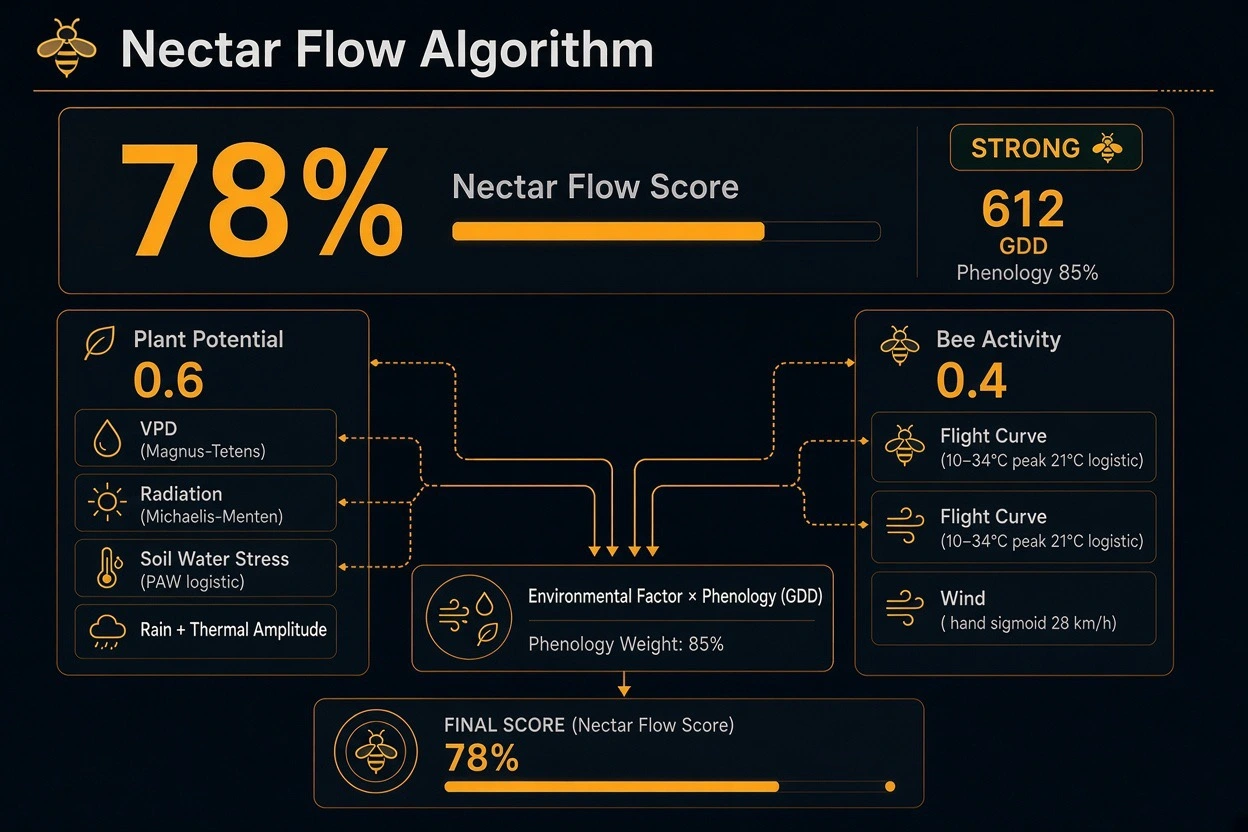
At Polinasyon Lab, we have restructured our nectar flow score engine in line with these agro-meteorological requirements. The new version goes beyond classical temperature-humidity equations and combines soil water stress, vapor pressure deficit (VPD), photosynthetic radiation layers and pine honeydew ecology under a single mathematical model framework.
For the heat accumulation formulations that form the core mathematics of the score, you can review our methodological article: How is the Nectar Flow Score Calculated with GDD?.
1. Phenological Shift and Heat Accumulation (GDD) Model
In plant production and nectar secretion, calendar dates are no longer decisive; plants develop according to the accumulated heat (GDD – Growing Degree Days) once thermal thresholds are exceeded.
- Early Warming Scenarios: When heat accumulation is completed earlier than normal, the nectar maximum of plants shifts forward; the flow window closes before the colony population reaches forager level.
- GDD Proportional Analysis: The updated engine calibrates the phenological stage in real time by comparing the current year with historical thermal data and provides the beekeeper with an objective regional adaptation score.
2. Vapor Pressure Deficit (VPD) and Soil Water Stress (FAO-56)
Even when air temperature and relative humidity appear suitable meteorologically, plant physiology can stop nectar production due to environmental stress factors. The new engine monitors these biological limits with two core models:
- Soil Water Stress (FAO-56 Approach): When available water reserves in the root zone are depleted, the plant increases stomatal resistance, limiting photosynthesis and nectar secretion. The model calculates the root-zone water stress coefficient according to soil type (sandy, loamy, clayey) and directly reflects drought pressure into the score.
- Vapor Pressure Deficit (VPD – Magnus-Tetens Model): The VPD parameter, which expresses the humidity deficit in the air, has been integrated into the algorithm as a critical threshold that triggers excessive increase in nectar viscosity or complete cessation of nectar secretion by the plant.
3. Pine Honeydew Ecology: Marchalina hellenica and Secretion Physiology
Flower nectar physiology and pine honeydew production are subject to completely different ecological parameters. In pine honey, the primary dynamic is not plant nectar but the activity and secretion stage of the organism Marchalina hellenica (the pine cottony scale).
When the flora type is defined as honeydew/pine, the new engine deactivates the flower nectar equations and activates a dedicated honeydew dynamics module:
- Thermal Optimum: Temperature deviations are evaluated using a Gaussian curve principle based on the 20°C band where secretion activity is maximized.
- Humidity Window: Extreme dryness or excessive humidity outside the optimal relative humidity range for pine honeydew (40% – 85%) analytically balances the secretion coefficient.
This approach aligns with field observations that temperature and humidity windows strongly influence Marchalina hellenica secretion dynamics in Mediterranean pine forests.
4. Diagnosis-Oriented Limiting Factor Analysis
Under the complex field conditions brought by the climate crisis, leaving the beekeeper with only a single score is not sufficient. The developed engine transparently diagnoses the main environmental factor producing a low score:
- It reports which of the parameters — soil water stress, air dryness (VPD), low solar radiation, wind gusts or nectar washout due to precipitation — plays the limiting role.
- This enables the beekeeper to make data-driven operational decisions at the hive (changing apiary location, supplementary feeding or harvest planning) rather than intuitive ones.
Frequently Asked Questions
How do pine honey and flower honey differ algorithmically?
While plant photosynthesis, VPD and soil water dominate in flower nectar, temperature and relative humidity ranges suitable for *Marchalina hellenica* metabolism (optimum 20°C and 40–85% humidity window) are taken as the basis for pine honey.Why does the updated engine produce more cautious (lower) scores in some cases?
Because the algorithm takes into account stress factors such as soil profile and vapor pressure deficit instead of superficial weather forecasts, it reflects the real biological constraints in the field. It continues to produce high potential when conditions are favorable.Can the engine continue to work in rural/mountainous areas with weak signal?
Yes. The system is designed with an offline-first architecture, so previously fetched data is stored in the browser cache and calculations can be performed even without an internet connection.What does limiting factor diagnosis mean?
It shows which main component is suppressing the score (e.g. wind, root dryness or VPD) and provides the beekeeper with diagnosis-oriented guidance.Explore the Decision Support Panel Now
To manage the field uncertainties of the climate crisis with scientific models:
👉 lab.polinasyon.org/nektar
About Polinasyon Lab:
Polinasyon Lab is a new-generation field decision support panel that combines nectar flow score, GDD-based phenology tracking and colony dynamics on a single screen for beekeepers and researchers, and can work offline.
Suggested Citation
Altıntaş, F. (2026). Nectar Flow Engine Update: Climate Crisis, GDD, VPD & Pine Honeydew Modeling. Polinasyon Lab Academy. https://www.polinasyon.org/blog/nectar-flow-engine-update-climate-crisis-pine-honeydew